
Failure Detection Window in Oil Analysis
Oil analysis is widely recognized as a predictive maintenance tool, but its effectiveness is governed by a factor that is rarely measured directly: the amount of time between when a failure first becomes detectable and when the machine ultimately fails.
This period, which can be called the Failure Detection Window (FDW), represents the total opportunity available to detect and correct a developing failure before it results in functional loss.
Understanding how to calculate and extend the Failure Detection Window allows maintenance organizations to improve reliability, optimize sampling intervals, and significantly reduce operating costs.
Defining the Failure Detection Window
The Failure Detection Window is the time interval between two specific events:
- The first detectable abnormal oil analysis result
- The point of functional failure, when the machine can no longer perform its intended function.
For example, consider a gearbox where iron levels begin rising abnormally on March 1, and the gearbox fails on September 1. In this case, the Failure Detection Window is 184 days.
This window represents the entire period during which intervention could have prevented catastrophic failure.
Calculating and Extending the FDW Using Existing Oil Analysis Data
Most organizations already have the data required to calculate Failure Detection Windows. The process involves reviewing historical oil analysis reports for equipment that experienced failure.
The steps are straightforward:
- Identify equipment that failed
- Review oil analysis history
- Locate the first report showing abnormal wear or contamination
- Identify the date of functional failure
- Calculate the time between these two events.
By repeating this process across multiple failures, patterns begin to emerge. These patterns help define typical Failure Detection Windows for different equipment types within your facility. This information is extremely valuable because it allows oil analysis programs to be designed based on actual machine behavior rather than assumptions.
FDWs Vary by Equipment Type
Failure Detection Window duration varies widely depending on equipment design and operating conditions.
Typical ranges include:
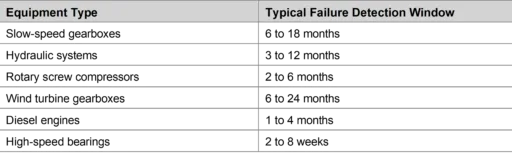
These differences are primarily due to how quickly failure mechanisms progress. Slow-speed equipment tends to fail gradually, providing long detection windows.
High-speed components can progress from early wear to catastrophic failure in a matter of weeks.
Sampling Interval Must Align
Oil analysis can only detect failure if sampling occurs during the Failure Detection Window. If the sampling interval exceeds the Failure Detection Window, failure may occur between samples without warning.
For example, if a compressor has a 90-day Failure Detection Window but is sampled every 180 days, there is a significant risk that failure will occur undetected.
A useful guideline is: Sampling intervals should not exceed one-half of the Failure Detection Window.
This improves the probability of detecting failure early enough to intervene.
How Detection Sensitivity Affects the Failure Detection Window
Failure Detection Window duration is influenced by how early failure can be detected.
Failure progression begins with the generation of extremely small wear particles. As damage progresses, particles increase in size and quantity.
Different oil analysis techniques detect wear at different stages:
- Spectrometric analysis (ICP) detects very small wear particles.
- Particle quantifier (PQ) index detects larger ferrous particles.
- Analytical ferrography detects a wide range of particle sizes and provides visual confirmation.
More sensitive detection methods identify failure earlier in its progression. This effectively extends the Failure Detection Window.
Extending the Failure Detection Window in Practice
While the physical progression of failure cannot be stopped, the effective Failure Detection Window can be extended by improving monitoring practices.
This can be accomplished through:
• Increasing sampling frequency
• Using more sensitive detection methods
• Improving sampling consistency
• Monitoring critical assets more closely
These steps allow failure to be detected earlier, providing more time for corrective action.
Economic Impact of Extending the FDW
The financial impact of extending the Failure Detection Window can be substantial. Consider a rotary screw compressor valued at $85,000.
The difference in outcome is determined by when the failure is detected. Not whether the failure occurs.
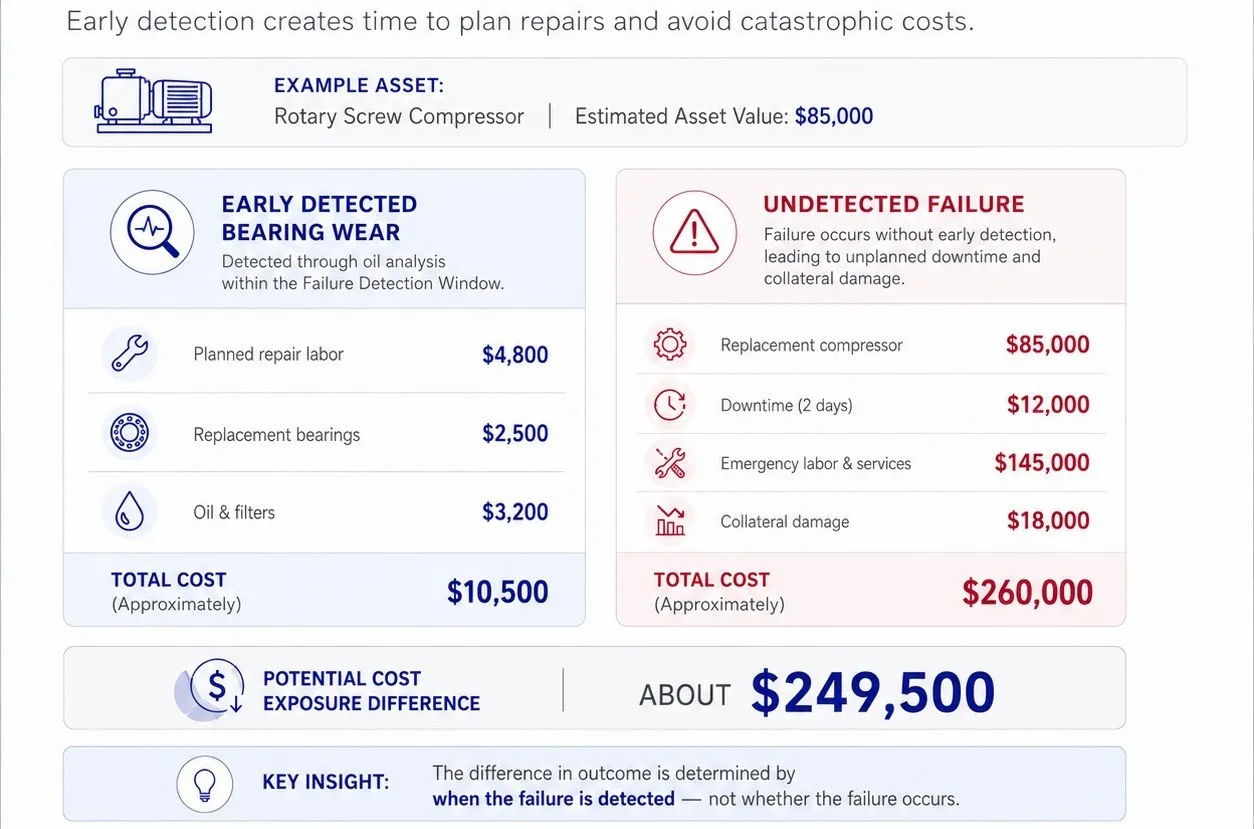
Extending the Failure Detection Window provides the time needed to plan repairs and avoid catastrophic consequences.
Oil Analysis Provides Time to Act
Oil analysis does not prevent mechanical failure. Failure progression is governed by physical conditions within the machine.
The value of oil analysis lies in detecting failure early enough to allow intervention. The Failure Detection Window represents this opportunity.
Organizations that understand and optimize this window can improve equipment reliability, reduce maintenance costs, and avoid unexpected downtime.
Conclusion
The Failure Detection Window is a practical and measurable concept that can be calculated using existing oil analysis data.
By understanding typical Failure Detection Windows for different equipment types and aligning monitoring practices accordingly, organizations can improve failure detection and reduce risk.
Extending the Failure Detection Window provides the time needed to plan maintenance, prevent catastrophic failure, and reduce overall operating costs.
Oil analysis delivers its greatest value not by preventing failure, but by providing the time required to respond effectively.
How early can you detect a developing failure? We’ll provide a site survey which will help assess the current Failure Detection Window and shape a tailored OCM service offering for each client. Stay tuned for more details.
Ready to strengthen your reliability strategy?
Bureau Veritas provides analytical fluid analysis across data center, nuclear, coal, natural gas, wind, and solar operations, helping operators protect critical cooling, lubrication, insulation, and fuel systems.
📩 ocminfo@bureauveritas.com

Author
Troy Goldman, CLS
Commercial Manager
Troy is an Oil Condition Monitoring Specialist with Bureau Veritas. He holds the Certified Lubrication Specialist (CLS) designation and specializes in oil analysis, predictive maintenance, and reliability program optimization.